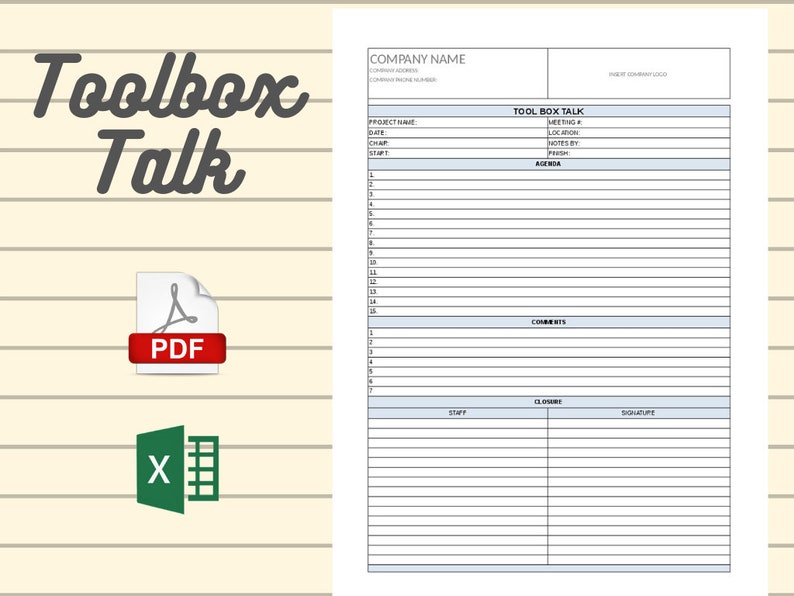
Workers get hurt not because they ignore safety, but because safety fades into background noise. A daily reminder—short, focused, real—can stop an injury before it happens. That’s where safety toolbox talks come in. And if you’re searching for safety toolbox talk topics pdf download, you’re not just looking for content. You need actionable, printable, easy-to-implement resources that fit into busy workflows and actually resonate with crews on the ground.
Generic PowerPoint slides or outdated PDFs with jargon-heavy paragraphs don’t cut it. What works are concise, visual, real-world discussions that supervisors can lead in 10 to 15 minutes—before the work begins.
This guide delivers exactly that: a clear path to high-impact toolbox talk topics, with insight into how to use them, where to find quality PDFs, and why most teams fail to sustain them.
What Are Toolbox Talks and Why They Matter
A toolbox talk is a short safety meeting, typically 10–15 minutes long, held at the job site before work begins. Unlike formal safety training, these are informal, interactive, and focused on a single hazard or safety practice relevant to that day’s tasks.
They’re called “toolbox” talks because they were traditionally held with crews gathered around the job site toolbox. Today, they’re a cornerstone of proactive safety culture across construction, manufacturing, oil and gas, utilities, and maintenance operations.
When Toolbox Talks Prevent Real Injuries
Consider this: a crew is scheduled to work on a rooftop HVAC unit. The foreman pulls up a toolbox talk on “Fall Protection for Low-Slope Roofs,” prints the PDF, and runs through it with the team. One worker mentions the anchor point looks loose. They inspect it—find corrosion—and delay work until it’s repaired.
That’s the power of a timely, relevant discussion. It’s not just compliance. It’s catching near-misses before they become incidents.
OSHA doesn’t mandate daily toolbox talks, but they strongly encourage them as part of effective safety and health programs. Companies with consistent talk schedules see fewer recordable incidents, better hazard awareness, and stronger crew accountability.
Common Mistakes That Kill Toolbox Talk Effectiveness
Too many teams treat toolbox talks like a checkbox activity. Here’s what goes wrong:
- Using the same 5 topics all year – Fall protection, PPE, fire safety—on repeat. Workers tune out.
- Reading from dense text – No interaction, no questions, just monotone delivery.
- No follow-up or documentation – No sign-in sheets, no records. If OSHA shows up, you can’t prove it happened.
- One-size-fits-all approach – A talk on electrical safety means nothing to a landscaping crew.
The result? Wasted time, disengaged workers, and zero impact on safety behavior.
What to Look for in a Quality Safety Toolbox Talk PDF
Not all downloadable PDFs are created equal. A good one should:

- Be no longer than 2 pages – one for the leader, one for handout or sign-in.
- Use simple language and visuals – icons, diagrams, or photos that illustrate the hazard.
- Include discussion questions – prompts like “What’s one near-miss you’ve seen with ladder use?”
- Highlight real-world scenarios – not theoretical risks, but typical job site mistakes.
- Offer customization space – areas to add site-specific details, date, and crew names.
- Include a sign-off section – for attendance tracking and compliance proof.
Avoid PDFs that read like OSHA manuals. You want conversation starters—not lectures.
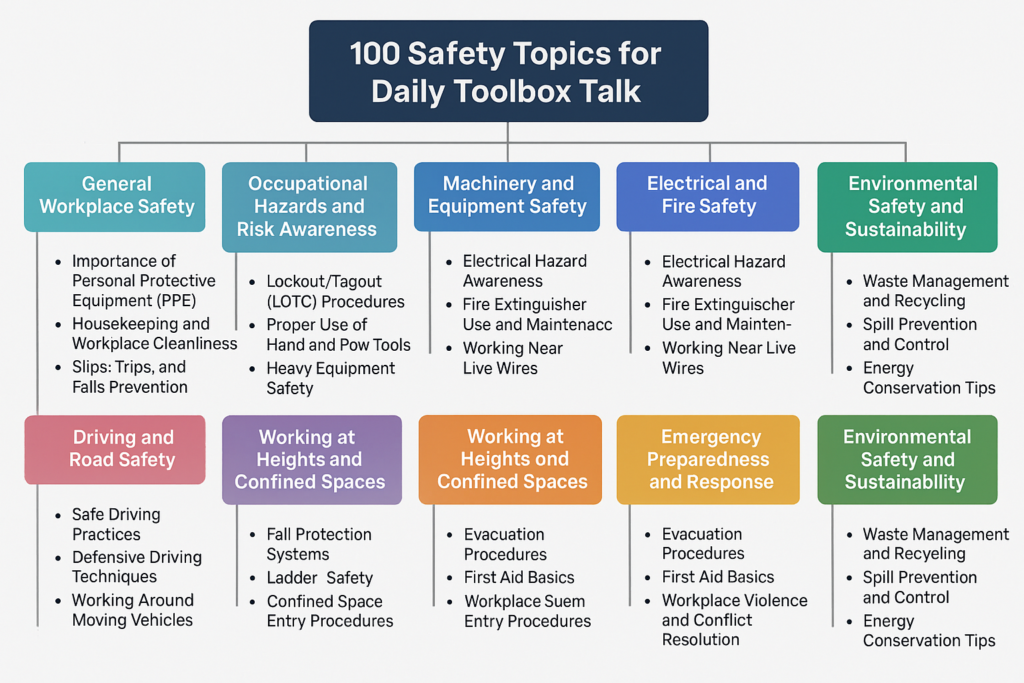
Top 10 High-Impact Safety Toolbox Talk Topics (With Use Cases)
These topics consistently address the most frequent and severe job site hazards. Each is ideal for a 10-minute discussion and works across industries.
1. Ladder Safety Use case: A painter climbs a 24-foot extension ladder daily. Discussion focus: 3-point contact, proper setup angle (4:1 rule), inspection for cracks or bent rungs. Common mistake: Carrying tools in hand instead of using a tool belt or hoist.
2. Hand Safety Use case: Mechanics using grinders, shears, or press machines. Discussion focus: Guarding, pinch points, glove selection (cut vs. heat resistance). Real example: A worker lost a fingertip because a rotating shaft caught a ring. Talk about jewelry removal.
3. Fall Protection Use case: Rooftop work, scaffolding, elevated platforms. Discussion focus: Anchor point checks, harness fit, fall distance calculation. Tip: Show how a 6-foot lanyard + harness stretch can result in a 12-foot fall.
4. Lockout/Tagout (LOTO) Use case: Maintenance on machinery. Discussion focus: Energy sources (electrical, pneumatic, hydraulic), verifying zero energy. Mistake: Skipping LOTO because “it’s just a quick fix.”
5. Electrical Safety Use case: Electricians, HVAC techs, equipment operators near power lines. Discussion focus: Voltage awareness, damaged cords, GFCI use, overhead line clearance. Stat: Over 400 U.S. workers die annually from electrocution.
6. Fire Extinguisher Use Use case: Welding, flammable storage, kitchen areas. Discussion focus: PASS technique (Pull, Aim, Squeeze, Sweep), inspection tags, class types (A, B, C). Drill idea: Hold one up and ask someone to demonstrate.
7. Hazard Communication (HazCom) Use case: Workers using solvents, cleaners, adhesives. Discussion focus: GHS labels, SDS access, proper ventilation, PPE. Check: Are SDS sheets actually available on site?
8. Slips, Trips, and Falls Use case: Warehouses, construction zones, wet environments. Discussion focus: Housekeeping, matting, proper footwear, cord management. Fact: These cause 25% of all workplace injuries.
9. PPE Inspection and Use Use case: Any crew entering a worksite. Discussion focus: Daily checks for hard hats, gloves, safety glasses, hearing protection. Example: A cracked hard hat may not stop a falling nut.
10. Hot Work Safety Use case: Welding, cutting, brazing. Discussion focus: Fire watch, permit requirements, combustible material clearance. Near-miss: Sparks igniting sawdust 10 feet away—was anyone watching?
Where to Find and Download Quality Toolbox Talk PDFs
You can create your own, but most supervisors don’t have time. That’s why downloadable PDFs are essential—especially ones that are pre-written, printable, and customizable.
Here are five trusted sources for safety toolbox talk topics PDF download:
| Source | Key Features | Best For |
|---|---|---|
| OSHA.gov | Free, government-reviewed, compliant | Basic templates, public sector teams |
| SafetyNow | 100+ topics, editable PDFs, tracking tools | Mid to large companies with safety software |
| Creative Safety Supply | Visual-rich, multilingual, industry-specific | Manufacturing, warehousing |
| Procore (Safety Library) | Integrates with project management, mobile access | Construction firms using Procore |
| SafetyTek | Modular talks, sign-in sheets, audit-ready | Field service, energy, utilities |
Pro tip: Always modify downloaded PDFs to include your company name, site-specific risks, and crew details. A generic talk loses credibility fast.
How to Run a Toolbox Talk That Actually Works
A great PDF is just the start. Delivery makes the difference.
1. Pick the Right Topic for the Day Match the talk to the work. No electrical talk if the crew is pouring concrete.
2. Do It at the Right Time
Before work starts—never at the end of the shift. Attention drops.
3. Keep It Interactive Ask questions. Get workers to share experiences. “Has anyone ever tripped over a trailing cord?”
4. Use the PDF as a Guide, Not a Script Don’t read it word for word. Talk like a human. Point to equipment on site.
5. Document Attendance Print the sign-in sheet from the PDF. File it weekly. Digital logs work too—if backed up.
6. Rotate Leaders Let crew members lead occasionally. Increases ownership and engagement.
Building a Sustainable Toolbox Talk Program
Most companies start strong in January and fade by April. Avoid this:
- Create a 52-week plan – Map out topics by season and project phase.
- Use a shared drive or app – Store PDFs so supervisors can access them from tablets or phones.
- Review near-misses monthly – Turn them into next week’s talk topic.
- Audit compliance quarterly – Check sign-in sheets, observe a few talks live.
A well-run program reduces incidents, but only if it’s consistent and relevant.
Download Ready-to-Use Safety Toolbox Talk PDFs Today
You don’t need to reinvent the wheel. High-quality, printable safety toolbox talk topics PDFs exist—designed by safety pros, tested on real crews, and built for compliance and impact.
Whether you’re a foreman, safety officer, or operations manager, your best move is to download a set of proven templates, customize them to your site, and start tomorrow morning.
Safety isn’t a policy. It’s a daily conversation. Make sure yours is worth listening to.
FAQ
Where can I get free safety toolbox talk topics PDF downloads? OSHA’s website offers free, printable toolbox talk templates. Many safety supply companies also provide free samples.
How long should a toolbox talk last? Aim for 10 to 15 minutes. Long enough to cover the topic, short enough to hold attention.
Do toolbox talks need to be documented? Yes. Attendance records protect your company during OSHA inspections and show due diligence.
Can I reuse the same topics every year? Yes, but rotate them strategically and update examples. Use past incidents to refresh content.
Should every crew member sign the PDF? Yes. Sign-in sheets confirm participation and are critical for compliance.
Can I edit downloaded toolbox talk PDFs? Most reputable sources allow editing. Always check licensing. Avoid locked or password-protected files.
How often should toolbox talks be held? Weekly is standard. High-risk sites may do them daily.
FAQ
What should you look for in Safety Toolbox Talk Topics PDF Download for Worksite Teams? Focus on relevance, practical value, and how well the solution matches real user intent.
Is Safety Toolbox Talk Topics PDF Download for Worksite Teams suitable for beginners? That depends on the workflow, but a clear step-by-step approach usually makes it easier to start.
How do you compare options around Safety Toolbox Talk Topics PDF Download for Worksite Teams? Compare features, trust signals, limitations, pricing, and ease of implementation.
What mistakes should you avoid? Avoid generic choices, weak validation, and decisions based only on marketing claims.
What is the next best step? Shortlist the most relevant options, validate them quickly, and refine from real-world results.