Every worksite faces the same challenge: how to consistently communicate safety without wasting time or sacrificing clarity. Toolbox talks are essential for reinforcing protocols, addressing hazards, and keeping compliance records—but drafting them from scratch every day slows teams down. That’s where a reliable, free toolbox talk template in Word format becomes indispensable.
A well-structured Word template streamlines safety meetings, ensures consistency, and supports documentation for audits or incident investigations. Whether you're in construction, manufacturing, utilities, or maintenance, using a template saves time and strengthens your safety culture. Below, we break down what makes a high-quality template, where to find trustworthy free versions, and how to maximize their value.
Why Use a Toolbox Talk Template in Word?
Microsoft Word remains the standard for document creation in most organizations. A toolbox talk template in Word allows safety officers and team leaders to edit, save, and share content efficiently—without relying on specialized software.
Key benefits include:
- Editability: Adjust sections, fonts, or branding to match company standards
- Accessibility: Nearly every office and jobsite has Word or a compatible viewer
- Print and Digital Use: Distribute via email, print for sign-in sheets, or upload to cloud drives
- Consistency: Standardize topics, hazard identification fields, and attendance logs
Without a template, safety briefings often become inconsistent or incomplete. A worker may skip critical warnings, fail to document attendance, or miss regulatory alignment. A structured Word document eliminates these gaps.
Core Components of an Effective Template
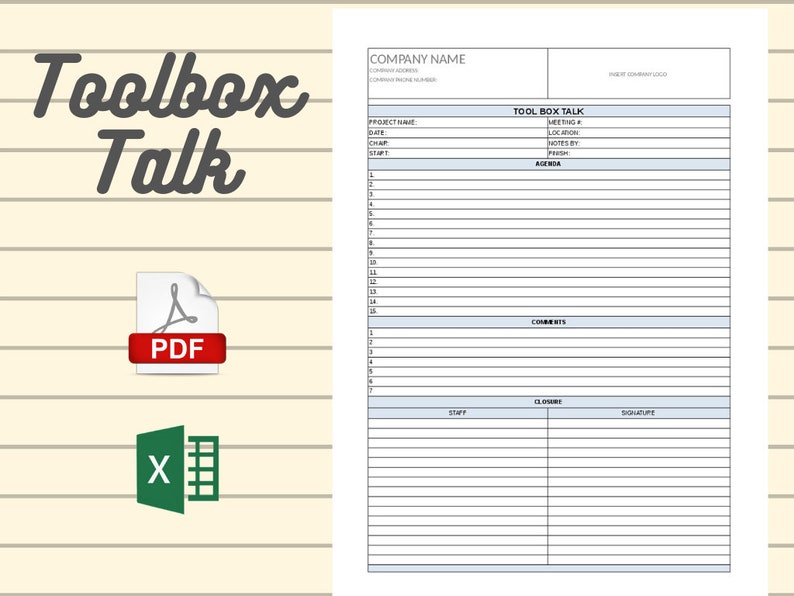
A free toolbox talk template should do more than list a topic. It must guide users through a complete safety conversation and support compliance. A high-quality Word version includes these sections:
#### 1. Meeting Header - Company name and logo - Date, time, and location of the talk - Supervisor or safety officer leading the session - Work crew or team names
#### 2. Topic and Objective - Clear title (e.g., "Working at Heights" or "Hazardous Material Handling") - Purpose of the talk: what attendees need to learn or remember
#### 3. Key Hazards - Bullet-point list of risks tied to the day’s work - Realistic examples: “Falling from unsecured ladders,” “Exposure to silica dust”
#### 4. Safety Controls - Required PPE, equipment checks, or procedural steps - Reference to company policies or OSHA standards
#### 5. Discussion Prompts - Questions like, “What near misses have you seen this week?” - Encourages engagement and peer-to-peer learning
#### 6. Sign-In Sheet - Table with columns: Name, Signature, Date, Role - Legally defensible record of attendance
#### 7. Incident Report & Action Items - Space to log concerns raised or follow-ups needed - Assign responsibility and deadlines

Templates missing any of these elements risk being superficial. A strong Word document balances structure with flexibility—allowing customization while ensuring nothing critical is skipped.
Common Mistakes in Using Free Templates
Even the best toolbox talk template fails if used incorrectly. Avoid these pitfalls:
- One-size-fits-all topics: Using a generic “Electrical Safety” talk when your team is doing confined space entry undermines relevance.
- Failing to customize: Leaving placeholders like “[Insert Company Name Here]” makes the document appear unprofessional and weakens accountability.
- Skipping the sign-in: No signatures = no proof of training. This becomes a liability during OSHA inspections.
- Reading verbatim: A toolbox talk should be a conversation, not a monologue. Use the template as a guide, not a script.
- Infrequent use: Doing talks only when required or before audits defeats the purpose. Consistency builds habits.
Pro tip: Schedule talks at the start of shifts, rotate facilitators, and link topics to upcoming tasks. For example, if crews are installing fall arrest systems, run a harness inspection talk that morning.
Where to Get a Reliable Free Toolbox Talk Template (Word Format)
Not all free downloads are created equal. Many templates online are outdated, poorly formatted, or filled with promotional content. Below are five reputable sources offering clean, professional Word-based templates—no login or email required.
| Source | Template Features | Download Format | Notes |
|---|---|---|---|
| OSHA.gov | Basic structure, compliance-focused | .doc | Government-backed but minimal design |
| SafetyCulture (iAuditor) | Modern layout, editable fields | .docx | Free account gives access to 10+ templates |
| Creative Safety Supply | Visual icons, multilingual options | .docx | Clean branding, easy to customize |
| Workplace Safety Blog | Industry-specific versions | .doc | Updated monthly; includes construction, warehouse, and lab variants |
| HSEDocs (UK-based) | ILO and ISO-aligned | .docx | Slight terminology differences but globally usable |
All these options are genuinely free, require no trial sign-up, and preserve your ability to edit and distribute internally. Avoid sites that promise “100 free templates” but gate content behind lead forms—those often repurpose low-quality content.
When downloading, verify: - The file is in .doc or .docx format - No embedded macros or suspicious links - Company branding can be added or removed easily
How to Customize Your Template for Maximum Impact
A blank template is just the start. To make it truly valuable, tailor it to your operations.
#### Step 1: Brand It Insert your logo, update fonts to match corporate identity, and add a footer with contact info. Professional appearance increases engagement.
#### Step 2: Preload Common Topics Create duplicate files for frequent subjects: - Ladder safety - Hot work permits - Lockout/tagout procedures - Fall protection - Slips, trips, and falls
Save them in a shared drive with clear naming: “Toolbox Talk – Fall Protection – Final.docx”
#### Step 3: Add Site-Specific Risks If your facility uses forklifts near pedestrian zones, include a scenario: “What should you do if a forklift blocks the emergency exit?” This builds situational awareness.
#### Step 4: Integrate with Daily Work Plans Link talks to the day’s JSA (Job Safety Analysis) or work permit. For example, if a crew is breaking concrete, pair the talk with silica exposure controls and respirator checks.
#### Step 5: Archive Completed Talks Save filled templates by date and location. Use a naming convention: “2025-04-05_TBT_SouthSite_Electrical.docx” This creates an auditable trail and helps track recurring issues.
Real-World Use Case: Construction Crew Rollout
A mid-sized electrical contractor with 12 field teams struggled with inconsistent safety briefings. Supervisors skipped talks or used handwritten notes, leaving no records.
They downloaded a free Word template from SafetyCulture, branded it, and pre-loaded 15 common topics. Each Monday, the safety manager emailed the week’s talks to leads. Supervisors were required to: - Deliver the talk within one hour of shift start - Print and collect signatures - Return completed docs by Friday
Within six weeks, attendance improved from 68% to 97%. During an OSHA audit, the complete documentation file helped them avoid citations. More importantly, near-miss reports increased—workers felt safer speaking up.
The template didn’t just save time. It changed behavior.
Limitations of Free Templates (And How to Overcome Them)
Free doesn’t mean perfect. Recognize these constraints:
- Generic language: May not reflect your equipment, layout, or team structure
- → Solution: Edit every talk to include site-specific details
- Static format: Word doesn’t track completion or send reminders
- → Solution: Pair with a simple shared calendar or spreadsheet tracker
- No analytics: Hard to measure engagement or knowledge retention
- → Solution: Add a short verbal quiz: “What’s one thing you’ll do differently today?”
For larger organizations, free Word templates are a starting point—eventually, digital safety platforms may offer more automation. But for most teams, a well-used Word file delivers 90% of the value at zero cost.
Final Tips for Sustainable Safety Communication
A toolbox talk template is a tool, not a magic fix. Its effectiveness depends on how you use it.
- Keep talks short: 10–15 minutes max. Focus on one clear topic.
- Encourage participation: Ask open-ended questions. Let workers share experiences.
- Act on feedback: If someone raises a hazard, address it—then report back.
- Review and revise: Every quarter, assess which topics are most relevant and update accordingly.
The best safety cultures don’t treat toolbox talks as a box-ticking exercise. They use them to build trust, reinforce standards, and protect lives.
Download a free toolbox talk template in Word today. Customize it, use it consistently, and turn daily safety meetings into a powerful force for change. The smallest investment in preparation can prevent the largest losses.
FAQ
What should you look for in Free Toolbox Talk Template Word Download for Safety Teams? Focus on relevance, practical value, and how well the solution matches real user intent.
Is Free Toolbox Talk Template Word Download for Safety Teams suitable for beginners? That depends on the workflow, but a clear step-by-step approach usually makes it easier to start.
How do you compare options around Free Toolbox Talk Template Word Download for Safety Teams? Compare features, trust signals, limitations, pricing, and ease of implementation.
What mistakes should you avoid? Avoid generic choices, weak validation, and decisions based only on marketing claims.
What is the next best step? Shortlist the most relevant options, validate them quickly, and refine from real-world results.